
Key takeaways
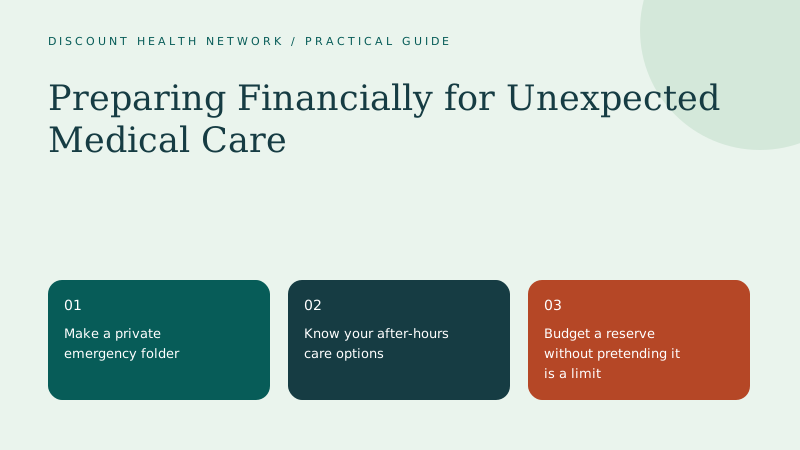
- Make a private emergency folder.
- Know your after-hours care options.
- Budget a reserve without pretending it is a limit.
Make a private emergency folder
Keep essential contacts, current coverage details, medication information, and relevant care instructions available to you or an authorized caregiver. Avoid placing sensitive details on public websites. Decide how a trusted person can access the information if you are unable to communicate.
Know your after-hours care options
Ask your established clinician or plan how to obtain after-hours guidance. Identify nearby appropriate facilities before you need them. This preparation helps navigation but cannot determine whether a future symptom is safe to manage outside an emergency department.
Budget a reserve without pretending it is a limit
Set a monthly savings amount that fits your circumstances. Label it as a reserve rather than a prediction of emergency costs. Insurance out-of-pocket maximums have exclusions and conditions, and uninsured bills can vary widely. A reserve supports flexibility but does not guarantee full financial protection.
Keep the first bills organized
After urgent needs are addressed, collect bills, explanations of benefits, receipts, and relevant notices. Separate organizations may bill for the same encounter. Track dates and questions before assuming that the first balance represents the complete final amount.
Review assistance and billing protections
Ask hospitals about financial-assistance policies and consult current CMS information about applicable medical-billing rights. Confirm deadlines and application requirements directly. Do not assume that a protection eliminates every bill or that a pending complaint pauses all collection activity.
Ask for help early
A trusted caregiver, hospital financial counselor, benefits counselor, or appropriate consumer professional may help organize next steps. Use official channels and share only necessary records. If symptoms worsen or new urgent concerns arise, medical reassessment takes priority over finishing paperwork.
Turn this into one useful conversation
Start with the organization responsible for the service or benefit. Explain the financial question clearly without sending unnecessary medical details. Ask for the actual price or rule that applies to your situation, what the answer excludes, and the next action you need to take. If a response is unclear, ask the staff member to explain it in ordinary language and point you to the written policy.
Keep a private record with the date, organization, contact person or reference number, question, response, and follow-up date. A website description can help you prepare, but the responsible provider, program, or plan must confirm the details. When comparing two options, use the same service, time period, and assumptions so the totals mean the same thing.
Make the numbers work together
Put any recurring cost into your health budget and set aside a separate monthly amount for known occasional expenses. Avoid counting the same expense twice: an annual bill entered in the annual-expense field should not also appear as a monthly payment unless those are genuinely separate costs. Keep savings reserves separate from actual care spending. A potential discount becomes verified savings only after you confirm the final price for an equivalent need.
Try this today
Choose one question from this guide. Write the current cost or unresolved issue, the organization you will contact, and the date you will follow up. Finishing that step is more valuable than collecting another unverified offer.
Your next three steps
- Review the official source below and choose one question to resolve.
- Contact the responsible organization to confirm the answer for your circumstances.
- Record the result and update your budget, comparison, or care plan as appropriate.
Frequently asked questions
Does this guide determine what I qualify for?
No. Eligibility, coverage, prices, and availability must be confirmed by the responsible program, plan, or provider.
Should I delay care while looking for a lower price?
Do not delay emergency care. Ask a qualified clinician about the timing of nonemergency care and discuss affordability problems before changing prescribed treatment.
Sources and scope
CMS Medical Bill Rights ↗ provides the official or program starting point for this topic. Source pages checked October 22, 2026. This article provides general financial-navigation information, not a determination of individual benefits, legal rights, tax treatment, or medical suitability.
Prepared by Discount Health Network editorial resources. No independent medical review is claimed. Read our editorial standards.