Key takeaways
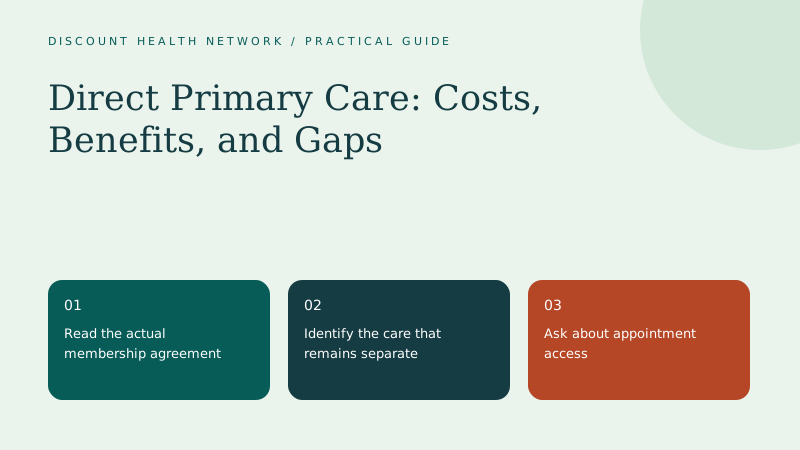
- Read the actual membership agreement.
- Identify the care that remains separate.
- Ask about appointment access.
Read the actual membership agreement
Ask what the recurring payment includes: office visits, virtual contact, procedures, tests, or coordination. Practices differ. Confirm enrollment charges, family pricing, cancellation terms, and whether the fee changes with age or service use. A membership label does not define a standard benefit package.
Identify the care that remains separate
Ask how specialists, hospital treatment, emergency care, imaging, and outside laboratory work are handled. A primary care relationship does not pay every health bill. Build those expenses into the broader budget instead of assuming the membership is a complete substitute for coverage.
Ask about appointment access
Find out how same-day concerns, vacations, after-hours questions, and urgent situations are managed. Access promises should be specific enough to understand. Ask who covers the practice when your clinician is unavailable and whether any additional fees apply.
Compare with your current routine spending
Add membership fees for the whole year and the expected cost of services outside the arrangement. Compare that with your current plan and self-pay options for the same care. Do not assume that paying a membership changes an insurer’s deductible or claim rules.
Check coverage and tax questions separately
Whether a specific arrangement interacts with insurance or tax-favored accounts depends on current rules and the agreement. Consult official guidance and an appropriate professional. Do not assume every membership payment is eligible for HSA reimbursement.
Plan continuity before joining
Ask how records are transferred, how prescriptions and referrals are managed, and what happens if you move or leave the practice. Keep the membership contract and cancellation instructions. Financial convenience is most useful when it supports an appropriate ongoing care relationship.
Turn this into one useful conversation
Start with the organization responsible for the service or benefit. Explain the financial question clearly without sending unnecessary medical details. Ask for the actual price or rule that applies to your situation, what the answer excludes, and the next action you need to take. If a response is unclear, ask the staff member to explain it in ordinary language and point you to the written policy.
Keep a private record with the date, organization, contact person or reference number, question, response, and follow-up date. A website description can help you prepare, but the responsible provider, program, or plan must confirm the details. When comparing two options, use the same service, time period, and assumptions so the totals mean the same thing.
Make the numbers work together
Put any recurring cost into your health budget and set aside a separate monthly amount for known occasional expenses. Avoid counting the same expense twice: an annual bill entered in the annual-expense field should not also appear as a monthly payment unless those are genuinely separate costs. Keep savings reserves separate from actual care spending. A potential discount becomes verified savings only after you confirm the final price for an equivalent need.
Try this today
Choose one question from this guide. Write the current cost or unresolved issue, the organization you will contact, and the date you will follow up. Finishing that step is more valuable than collecting another unverified offer.
Your next three steps
- Review the official source below and choose one question to resolve.
- Contact the responsible organization to confirm the answer for your circumstances.
- Record the result and update your budget, comparison, or care plan as appropriate.
Frequently asked questions
Does this guide determine what I qualify for?
No. Eligibility, coverage, prices, and availability must be confirmed by the responsible program, plan, or provider.
Should I delay care while looking for a lower price?
Do not delay emergency care. Ask a qualified clinician about the timing of nonemergency care and discuss affordability problems before changing prescribed treatment.
Sources and scope
HealthCare.gov ↗ provides the official or program starting point for this topic. Source pages checked October 22, 2026. This article provides general financial-navigation information, not a determination of individual benefits, legal rights, tax treatment, or medical suitability.
Prepared by Discount Health Network editorial resources. No independent medical review is claimed. Read our editorial standards.