Key takeaways
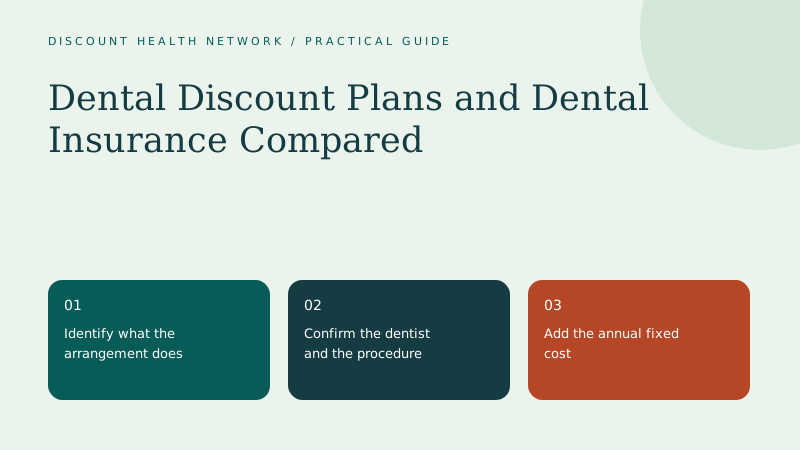
- Identify what the arrangement does.
- Confirm the dentist and the procedure.
- Add the annual fixed cost.
Identify what the arrangement does
Insurance pays covered benefits according to a policy. A discount plan generally offers access to participating-provider prices, with the patient paying the discounted bill. Read the actual contract rather than relying on the product name. Neither arrangement guarantees that every procedure or dentist is covered.
Confirm the dentist and the procedure
Call the specific office and ask whether it accepts the exact plan for the treatment you need. A directory can be out of date. Request the expected patient price, participating-provider conditions, and any excluded charges. Do not enroll based only on the presence of a familiar dental practice name.
Add the annual fixed cost
Compare premiums or membership dues, enrollment fees, deductibles, expected treatment payments, and any applicable benefit maximum. Use the same anticipated treatment across options. A hypothetical $120 membership that reduces one bill by $80 would not create net savings for that bill alone.
Read timing and coverage limits
Insurance may have waiting periods, frequency rules, exclusions, and annual benefit limits. Discount plans may have their own activation, renewal, and cancellation terms. Ask when the arrangement takes effect and whether work already recommended or begun is eligible.
Avoid a comparison based on percentages alone
“Up to” savings depend on the fee schedule and the service. Ask for the actual dollar amount for your proposed treatment. Compare it with a direct self-pay quote and any appropriate clinic option. A large advertised percentage is less helpful than a written total for the care you need.
Keep treatment decisions with the dentist
A financial arrangement should support appropriate care. Ask which procedures are urgent, which can wait safely, and whether there are clinically reasonable alternatives. Keep a copy of the treatment plan and plan documents so later billing questions can be answered against the original terms.
Turn this into one useful conversation
Start with the organization responsible for the service or benefit. Explain the financial question clearly without sending unnecessary medical details. Ask for the actual price or rule that applies to your situation, what the answer excludes, and the next action you need to take. If a response is unclear, ask the staff member to explain it in ordinary language and point you to the written policy.
Keep a private record with the date, organization, contact person or reference number, question, response, and follow-up date. A website description can help you prepare, but the responsible provider, program, or plan must confirm the details. When comparing two options, use the same service, time period, and assumptions so the totals mean the same thing.
Make the numbers work together
Put any recurring cost into your health budget and set aside a separate monthly amount for known occasional expenses. Avoid counting the same expense twice: an annual bill entered in the annual-expense field should not also appear as a monthly payment unless those are genuinely separate costs. Keep savings reserves separate from actual care spending. A potential discount becomes verified savings only after you confirm the final price for an equivalent need.
Try this today
Choose one question from this guide. Write the current cost or unresolved issue, the organization you will contact, and the date you will follow up. Finishing that step is more valuable than collecting another unverified offer.
Your next three steps
- Review the official source below and choose one question to resolve.
- Contact the responsible organization to confirm the answer for your circumstances.
- Record the result and update your budget, comparison, or care plan as appropriate.
Frequently asked questions
Does this guide determine what I qualify for?
No. Eligibility, coverage, prices, and availability must be confirmed by the responsible program, plan, or provider.
Should I delay care while looking for a lower price?
Do not delay emergency care. Ask a qualified clinician about the timing of nonemergency care and discuss affordability problems before changing prescribed treatment.
Sources and scope
NIDCR Finding Dental Care ↗ provides the official or program starting point for this topic. Source pages checked October 22, 2026. This article provides general financial-navigation information, not a determination of individual benefits, legal rights, tax treatment, or medical suitability.
Prepared by Discount Health Network editorial resources. No independent medical review is claimed. Read our editorial standards.